You’ve got two browser tabs open. One is a GoDaddy checkout with SSL certificates, domain privacy, site security, and an SEO toolkit all pre-added to the cart, quietly pushing your total well past what you expected to pay. The other is Namecheap, showing your domain, a privacy protection line item that reads “Free,” and not much else. The contrast alone is why so many people switch registrars and never look back.
That reputation is well earned, and it’s the first thing worth understanding about Namecheap. But domains and hosting are two different products wearing one brand name, and the story changes considerably once you look at what happens after you buy the domain and decide to host a site on the same platform. This review covers both halves honestly.
What Is Namecheap, Exactly?
Namecheap is a domain registrar and web hosting company that built its reputation primarily on the registrar side of the business — buying, transferring, and managing domain names — before expanding into shared hosting, managed WordPress hosting, VPS, and dedicated servers. It’s one of the larger independent registrars, competing directly against GoDaddy on price and, more pointedly, on how it treats customers during checkout.
That founding identity as a no-nonsense domain shop still shapes the brand today, even as it’s grown into a broader hosting provider. Understanding that history helps explain why its two product lines get reviewed so differently by the same people.
Domain Pricing in 2026: The First Year vs. the Renewal
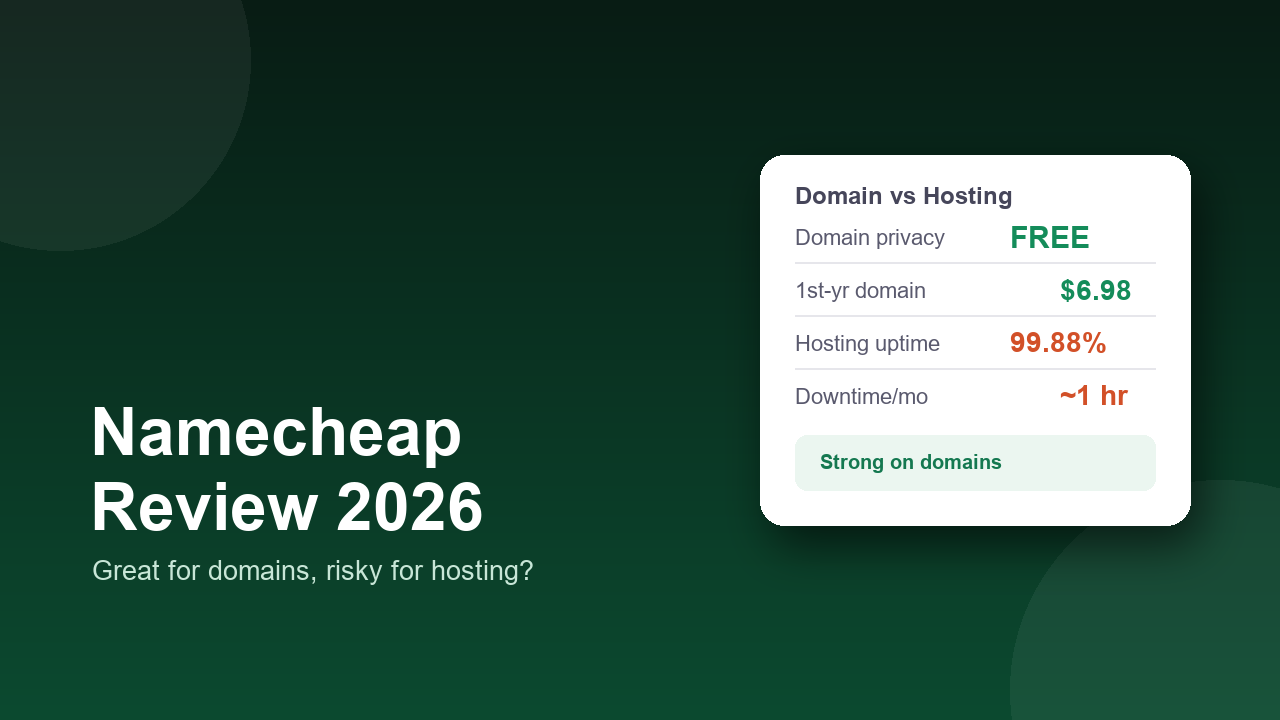
A .com domain’s first-year price is genuinely competitive, often landing in the $6.98 to $8.98 range during regular promotions. Renewal pricing is higher, as it is everywhere in this industry, typically running $13.98 to $15.88 a year depending on current rates and the specific extension. A .net domain renews around $15.98 a year, and a .org around $14.98 a year.
The gap between first-year and renewal pricing is real, but it’s worth putting in context: this pattern is standard across essentially every domain registrar, and Namecheap’s renewal rates are still generally competitive against GoDaddy and most other major players, rather than the dramatic multi-hundred-percent jump you’ll see with some hosting promotions. Budget for the renewal rate from the start, but it’s not the kind of shock that defines Namecheap’s reputation.
Free WhoisGuard: The Feature That Built Namecheap’s Reputation
This is the detail that actually explains why Namecheap has such a loyal following, and it’s worth spelling out clearly. Every new domain registration or transfer on an eligible TLD comes with WhoisGuard, Namecheap’s domain privacy protection, free for life — not free for the first year, not a discounted add-on, genuinely free for as long as you own the domain.
Compare that to the traditional industry approach: GoDaddy has historically bundled privacy free for year one and then charged around $9.99 to $20 a year after that. Over five years, that gap alone can add over $150 to the true cost of owning a single .com domain elsewhere, money that never leaves your account if you’re registered through Namecheap. GoDaddy has since started including basic privacy on more of its plans, narrowing the gap, but Namecheap was doing this years before it became common practice, and that head start is a real part of why the brand earned its reputation for being the straightforward, non-predatory option.
Namecheap Hosting Pricing: Shared, EasyWP, VPS, and Dedicated
Namecheap’s shared hosting starts cheap — Stellar, the entry-level plan, runs as low as $1.91 to $3.88 a month depending on current promotions, bundling in a free domain, 20GB of SSD storage, and support for up to three websites. Stellar Plus moves up to roughly $2.98 a month introductory, renewing around $7.48 a month, and Stellar Business starts near $4.98 a month, renewing around $11.98 a month.
For WordPress specifically, EasyWP is Namecheap’s managed hosting product. The Starter tier includes a free first month before renewing at $9.88 a month, Turbo runs $13.88 a month introductory with a $18.88 renewal, and Supersonic starts around $20.88 a month, renewing at $26.88. Beyond shared and managed WordPress hosting, VPS plans start at $3.88 a month, and dedicated servers start around $37 a month for anyone who’s outgrown shared infrastructure entirely.
Beyond Domains and Hosting: Email and SSL
Namecheap also sells Private Email hosting separately from its web hosting plans, which is worth knowing about even if you host your site elsewhere. It’s a straightforward, professional inbox tied to your domain — the kind of thing a freelancer or small business needs without wanting to pay Google Workspace or Microsoft 365 prices just to get a “you@yourdomain.com” address. Pricing sits well below the major providers, though the feature set is correspondingly more basic; don’t expect the depth of collaboration tools that come with a full Workspace or 365 subscription.
SSL certificates are the other add-on worth a mention. Namecheap sells a range of SSL options, from free basic certificates bundled with hosting plans to paid certificates from established certificate authorities for businesses that need extended validation. For most small sites, the free option bundled with hosting or available through a service like Let’s Encrypt covers what you actually need, so it’s worth checking what’s already included before paying extra here.
The Uptime Problem: Where Namecheap’s Reputation Splits in Two
Here’s where the two-product story gets its sharpest edge. Namecheap advertises strong uptime commitments, but independent testing tells a more mixed story. Recent measurements have put real-world uptime somewhere between 99.876% and 99.91% — numbers that sound close to perfect on paper but translate to over an hour of downtime in an average month, which falls short of what the marketing implies and is a meaningfully worse track record than the top-tier hosting providers in this category.
For a personal blog or a low-stakes side project, an hour of downtime a month is rarely the end of the world. For a business site, a store, or anything where an outage costs you money or credibility, that gap matters, and it’s the single most consistent criticism across independent hosting reviews. If uptime reliability is a top priority, it’s worth weighing that data specifically rather than assuming a well-known brand name guarantees enterprise-grade infrastructure.
Shared hosting, by its nature, also ties your site’s performance partly to what else is running on the same server. A resource-intensive neighbor having a bad day can drag down sites around it, which is part of why the uptime numbers on entry-level shared plans tend to look worse than what you’d see on VPS or dedicated infrastructure from the same company. If reliability matters and budget allows, stepping up a tier can meaningfully change the experience.
Customer Support: Great Documentation, Inconsistent Human Help
Namecheap’s knowledge base and self-service documentation get consistently strong marks — if you’re comfortable troubleshooting with a well-written FAQ, you’ll likely find your answer without ever needing to contact anyone. Where the experience gets shakier is direct human support. Live chat responds quickly, which is a genuine point in Namecheap’s favor, but reviewers frequently note that the actual answers provided for more technical hosting questions lack depth, and phone support isn’t readily available the way it is with some competitors.
This pairs uncomfortably with the uptime concerns above: if your hosted site goes down and the self-service documentation doesn’t cover your specific situation, the human backup isn’t always equipped to dig deep enough to resolve it quickly. For domain-only customers, this rarely becomes an issue, since domain management questions are usually straightforward enough for the knowledge base to handle.
Namecheap vs. GoDaddy and Cloudflare
Against GoDaddy, Namecheap wins clearly and consistently on checkout experience and long-term cost of ownership, mostly thanks to free lifetime privacy protection and a much less aggressive upsell flow. GoDaddy’s brand recognition and broader product ecosystem are real advantages for some buyers, but on pure value for a domain purchase, Namecheap is generally the better deal.
Against Cloudflare, which also offers domains at close to wholesale cost with free privacy included, the comparison is closer. Cloudflare tends to appeal more to technically sophisticated buyers who want domains registered at cost with minimal frills, while Namecheap offers a more complete, beginner-friendly ecosystem — hosting, email, SSL, and a more traditional account dashboard — bundled under one brand.
Who Should Actually Use Namecheap?
For buying and managing domains, Namecheap is a strong, low-friction choice for nearly anyone — the free privacy protection alone makes it worth strong consideration even if you plan to host your site somewhere else entirely. That’s true whether you’re registering one personal domain or managing a portfolio of them for client work.
For hosting specifically, it’s a reasonable fit for personal projects, blogs, and small sites where occasional downtime isn’t going to cost you real money or reputation. If you’re running a business-critical site, an online store processing real transactions, or anything where uptime reliability directly affects revenue, it’s worth weighing Namecheap’s real-world uptime numbers against hosting providers with a stronger track record before committing, even if it costs a bit more per month.
Freelancers and small agencies managing domains on behalf of clients also tend to do well with Namecheap specifically for the registrar side — a clean dashboard for managing dozens of domains, combined with free privacy protection across all of them, adds up to real savings and less administrative overhead compared to juggling client domains across pricier registrars. Just be intentional about where you point the actual hosting for anything client-facing and revenue-generating.
Frequently Asked Questions
Is Namecheap worth it in 2026?
For domain registration, yes, consistently — the combination of competitive pricing and free lifetime privacy protection is hard to beat. For hosting, it depends on your risk tolerance for downtime; it’s a reasonable choice for smaller, lower-stakes sites but less ideal for business-critical projects.
How much does a Namecheap domain actually cost?
First-year pricing for a .com is often $6.98 to $8.98 during promotions, with renewal typically running $13.98 to $15.88 a year. Other extensions like .net and .org renew in a similar range, generally $14.98 to $15.98 a year.
Is Namecheap’s domain privacy really free forever?
Yes, on eligible TLDs. WhoisGuard is included free for life with new registrations and transfers, not just the first year, which sets Namecheap apart from registrars that historically charged an ongoing fee for the same protection.
Is Namecheap hosting reliable?
It’s mixed. Independent uptime testing has shown results between roughly 99.876% and 99.91%, which amounts to over an hour of downtime in a typical month and falls short of top-tier hosting performance. It’s fine for low-stakes sites but worth scrutinizing for anything business-critical.
Does Namecheap have good customer support?
The self-service knowledge base is strong, and live chat response times are fast, but reviewers frequently describe the depth of technical answers as inconsistent, and phone support isn’t broadly available. Domain questions are usually well handled; complex hosting issues sometimes aren’t.
Is Namecheap better than GoDaddy?
For domains, generally yes — Namecheap’s free lifetime privacy protection and cleaner checkout make it the better value in most comparisons. For hosting, it depends on your priorities, since GoDaddy’s infrastructure has its own trade-offs and neither company is the clear leader on uptime reliability.
Does Namecheap offer email hosting and SSL certificates too?
Yes. Private Email hosting is sold separately from web hosting and offers a professional, domain-based inbox at a lower price than Google Workspace or Microsoft 365, with a correspondingly simpler feature set. SSL certificates range from free options bundled with hosting to paid certificates for businesses needing extended validation.
Final Verdict
Namecheap earns its reputation on exactly the product it was built around: domain registration that’s competitively priced, transparently sold, and backed by free privacy protection that costs real money elsewhere. That part of the business is easy to recommend without much hesitation.
The hosting side is a different conversation. It’s affordable and beginner-friendly, but the uptime data doesn’t match the reliability you’d want for anything where downtime has a real cost, and support quality thins out exactly when hosting problems get technical. Buy your domain here with confidence. Before you host your business on the same account, look at the uptime numbers specifically and decide whether the savings are worth the trade-off.
Disclosure: this post contains affiliate links. If you sign up through them, AffYogi may earn a commission at no extra cost to you.